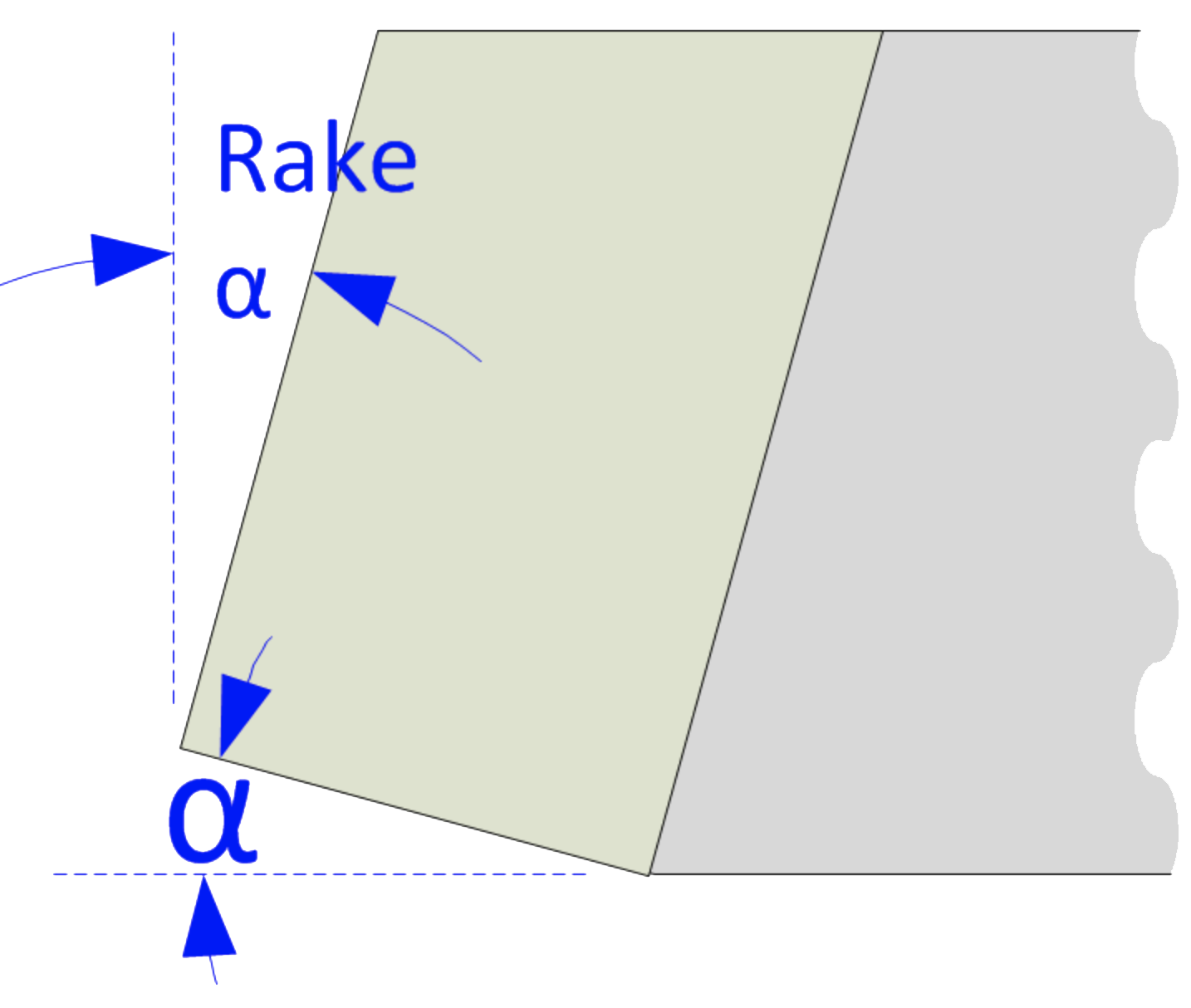
Edge angle
A positive rake angle is recommended by many as it reduces the chance to grab.
Be sure not to have the top of the curve to project forward from the center. To help with this, rotate in one direction only. Between rotations, lift the edge from the stone surface. This prevents working the centre more than the top edges.
Grind until you feel a burr raised along the entire edge, then hone the gouge to remove the burr.
|
Every woodworker needs a fireplace.
Unknown
|
|
General Guidelines
|
|
Edge
|
Rake
|
Tormek Jig
|
JS
|
P
|
TTS-100 Hole
|
|
Comments
|
|
α
|
Range
|
β
|
Range
|
|
45°
|
35° - 45°
|
20°
|
0° - 25°
|
SVD-186
|
0
|
65 mm
|
A
|
|
JR DUBUY on the Tormek forum recommended using the Tormek SVD-186 Gouge Jig with these settings. It works quite well.
|
|
35°
|
35° - 45°
|
20°
|
0° - 25°
|
SVS-50 Open Seat
|
0°
|
55 mm
|
B
|
|
Alan Batty recommended 45°, and this is generally recommended by many. I certainly recognize Mr. Batty's proven experience, but I've found that the 35° realized with these Tormek settings works extremely well.
Use with the Tormek SVS-50 Multi Jig with the Open Seat.
|
Notes & Comments
Marty Kiminsky noted that an Edge α of 40° to 45° is generally recommended for this tool, and that his personal preference is 40°. See also, "Woodturning" magazine, issue # 352.
Sharpness Scale

Example icon
Sharpness scales (as shown in the grey icon to the left) are used to indicate the recommended sharpness for the blades noted above. You can click on any of the icons showing the sharpness scale and be redirected to the page describing this more. Lower numbers are duller; higher numbers sharper.
These are general recommendations; you will need to use your own judgment, based on the knive’s intended purpose.
More Information
Books & Papers
- Alan Lacer wrote an article for the AAW titled "Learn to Sharpen Your Turning Tools" where he recommended 10° for the rake angle.
- “Woodturning”; magazine, issue # 352.
Videos & Presentations
- Jeff Farris
- Alan Holtham
- Tormek's Videos
- Tormek Sharpening Classes: Part 5 - Woodturning Tools (YouTube video). Want to learn how you get your woodturning tools razor-sharp? In this week's sharpening class we take a closer look at the tools for the woodturner; Gouges, skews, parting tools, scrapers, cutters and more. Sèbastian and Wolfgang will show you the methods for sharpening all these turning tools and how you achieve repeatable edges every time. Stay tuned and hit us with your questions during the stream.
- Tormek Live Sharpening Class - Part 9 - Sharpen a flat bevel with Tormek MB-100 on a diamond wheel (YouTube video). Sèbastian and Wolfgang show how to achieve a flat bevel with your Tormek wet sharpening system, They also touch upon the differences between the different types of bevels.
- Tormek Sharpening Classes: Part 23 - Reshaping woodturning tools on a bench grinder (YouTube video). In this episode of the Tormek sharpening classes we explain how you can quickly and with full control, re-profile your turning tools on your bench grinder. The BGM-100 Bench Grinder Mounting Kit allows you to use the same jig settings as on your water-cooled Tormek sharpening system. It is therefore easy to do the rough shaping on the bench grinder and then continue to sharpen and maintain the edge of your Tormek machine.
|
- Tormek's Videos (continued)
|
Web Sites
- TurnAWoodBowl.com is a pretty good reference site for sharpening bowl gouges, especially as it regards the bevel angle you might select. (But it does have a LOT of advertisements on the site -- bit on the annoying side.)