|
Because sharp enough ... usually is not |

|
Getting More Life From Your Grindstones
On the larger Tormek grinders (T-2000, T-7, & T-8), the traditional grindstone (not the diamond ones) starts out at 250mm diameter, and over time, wears down with use. But the sharpener should remember, grindstones are like wood pencils or brake shoes - consumables meant to be worn down with use. And, when the grindstone gets down to about 190mm, it is basically not usable as it won't reach down into the water any more.
Fortunately, there are things you can do. But please note: experience has shown that there are limits to this endeavour. When sharpening knives with long blades on a grindstone which has too small of a diameter, the side-to-side movement of the knife will be limited by the honing wheel or some other part on the Tormek machine's base. This happens when pulling the knife towards the honing wheel (the LA-220 Honing Wheel is 220 mm in diameter). On the larger units (T-8, T-7, & T-2000) there is a minimum size limit of 180 mm. This is driven by the fact that, the Micro Adjust nut on the US-105 Universal Support prevents the TT-50 Truing Tool from being used on grindstones smaller than 180 mm. | ||||||||||||||||||||||||||||||
Smaller Stones = Slower Grinding
Grinding speed decreases with grindstone diameter
A word of note: As the grindstone gets smaller, it takes longer to sharpen an edge. This is because the grinding speed is related to the grindstone’s diameter according to this equation: \begin{align*} Grinding \, Speed &= Grindstone \, Diameter \times \pi \times Grinder \, Speed\\ \end{align*} The Tormek T-8 grinder runs at 100 rpm. Using that, we can compare a 250 mm grindstone (equation 1 below) to a one which has been ground down to 180 mm (equation 2). \begin{align*} \tag{1} Grinding \, Speed_{250mm} &= 250 \; mm \times \pi \times 100 \; rpm \\ &= 78,539.8 \; mm/min\\ &\approx 4.3 \; ft/sec\\ \\ \tag{2} Grinding \, Speed_{180mm} &= 180 \; mm \times \pi \times 100 \; rpm \\ &= 56,548.7 \; mm/min\\ &\approx 3.1 \; ft/sec\\ \end{align*} This is not a huge difference, but there is one sharpener who replaces his grindstones when they get to 220mm. As shown in the chart to the right, at 220mm, the speed is down to 88%. By the time the grindstone has worn down to 180mm, it is 72% of the speed that it was when new. | ||||||||||||||||||||||||||||||

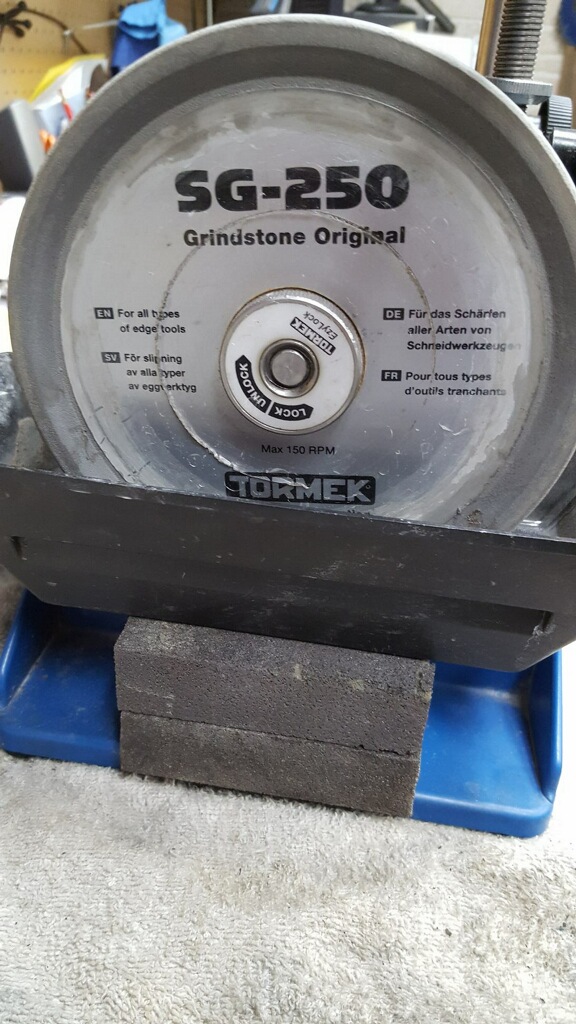
Wood used to raise the trough Option 1 : Raise the Water TroughYou can adjust the water level on the T-8 using the built-in feature. This is not a feature on the T-7 nor the T-2000. The picture to the right shows the T-2000's water trough sitting on ¾ inch thick plywood which is screwed to a 2x4. This sets the water trough about 2 ½ inches (64 mm) above the base, which is about ½ inches (14 mm) higher than if the trough were hung normally on the machine's tabs. Raising the water trough like this, raises the water level, allowing for use of more of the grindstone. And, as the grindstone is worn down to a smaller diameter, there is no issue with it rubbing on the bottom of the trough. It isn't pretty, but it does work well (kinda like me). | ||||||||||||||||||||||||||||||
Option 2 : Use the Worn Grindstone on a T-3 or T-4The grindstones from a bigger machine, once worn down to 200mm or less, will fit on a smaller machine. The grindstone is 50 mm wide (vs. the normal 200mm grindstone which is 40 mm wide), but it still fits. And, as noted in the table below, it gets another 51% out of the same stone.
Dan @ Exact Blade does this, and has provided the pictures below.
| ||||||||||||||||||||||||||||||